The Unexpected Mirror: What My Epilepsy Taught Me About Our Phone Habits
Aug 25, 2026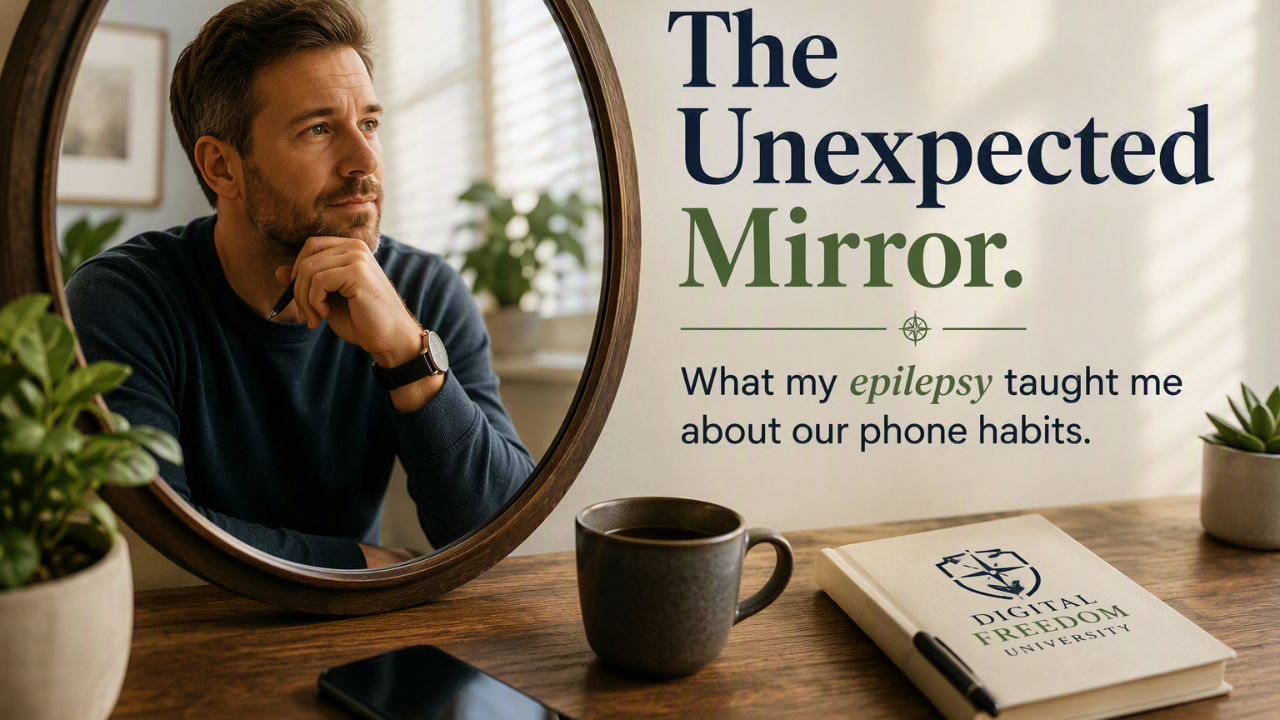
The Unexpected Mirror: What My Epilepsy Taught Me About Our Phone Habits
Imagine you and I are standing in a hallway chatting after a class or meeting. Suddenly, in the middle of our conversation, my tone shifts.
I start repeating, "Mmm-hmm, okay... mmm-hmm, okay," over and over again. My eyes drift away from yours, staring blankly ahead. My fingers begin tapping rhythmically together. A minute later, the moment passes—and I have zero memory of a single word you just said to me.
As a diagnosed epileptic, that is what a temporal lobe focal seizure looks like for me. It’s a temporary neurological short-circuit that cuts me off from the present moment. It impairs my awareness of what’s going on around me.
Now, picture a different scenario.
You’re hanging out with friends or sitting at the dinner table with your family. In the middle of a story, your phone buzzes in your pocket. Instinctively, your hand reaches out. You pull the device up, and your eyes lock onto the glowing glass.
You stop making eye contact with the people in the room. Your fingers impulsively begin tapping away at the screen to clear a notification—regardless of whether it actually mattered. And to keep up the appearance of staying involved in the room, you nod along, repeating under your breath: "Mmm-hmm, okay... mmm-hmm, okay." Sound familiar?
When you put the two scenes side-by-side, the physical reality is startlingly identical. The only difference? My episode is a medical condition. Yours is a digital seizure. The good news? My medical seizures are involuntary but our digital seizures are impulses we can learn to better control.
The Anatomy of a Digital Seizure
None of us are immune to this. A digital seizure occurs whenever a high-dopamine notification, an endless scrolling feed, or an impulsive checking habit short-circuits your presence. It pulls you out of real time and locks you into a micro-trance.
When you are in the middle of a digital seizure:
- Your attention is fragmented: You are physically in the room, but mentally miles away.
- Your eye contact disappears: Human connection gives way to screen gaze.
- Your memory formation stops: Just like my medical seizures prevent my brain from storing short-term memories, being distracted by your screen prevents you from really absorbing the world around you.
Going through a few digital seizures may not sound like a big deal. Because really, just a handful of them wouldn't be a big deal. The problem in today's digital world is that our time and attention is what the tech industry is spending billions of dollars to get a hold of. And as much of it as possible. And if we let them, they distract us from doing the important things we really want to get out of life. Because fulfilling life stories are made up of the things we learn and accomplish, the people we meet and the relationships formed, and the meaningful memories we create and hold onto. When we allow our day to be broken up by dozens of digital seizures, we aren't just checking notifications—we are leaving blank pages in our life stories and those of our friends and family.
The Power of Intention
Our digital devices are not inherently evil. They hold incredible potential to empower us, connect us, and streamline our lives. But depending on how we handle them, they will either serve our goals or hold us back. It takes having a vision of what we ultimately want to get out of life. Once we do that, our mentality changes to one of being motivated to create a better life for ourselves and others.
James Clear, author of the 25-million-copy bestseller Atomic Habits, taught a profound truth about human nature:
“When you envision what you want your life to be like, it is easy to see the value in taking actions with long-term benefits. We all want better lives for our future selves.”
Nobody envisions a future self who looks back on life wishing they had cleared more app notifications or spent three more hours a day scrolling through short-form videos. We want a future self rich in deep relationships, real-world achievements, and unforgettable memories.
To build that future, we have to start recognizing when a digital seizure is taking over our present.
Today’s 60-Second Action Step
Today, practice becoming a scientist of your own behavior.
Notice the exact moment your hand reaches for your phone while someone else is speaking to you. Catch yourself mid-motion. Instead of unlocking the screen, leave the phone face down, make eye contact, and give the person in front of you 100% of your presence.
What’s Next?
Understanding what a digital seizure looks like is only the first step. Over the next few weeks, we’ll dive into The 7 Types of Digital Seizures (from Social to Emotional) and how to identify which one is affecting your home culture the most.
Want 60-second daily strategies to master technology instead of letting it master you? Join other readers taking back their focus with Digital Wisdom Daily. Subscribe today at DigitalSeizures.com or Download your Digital Wellness Self-Assessment to see where you should begin making improvements today!